 |
|
 |
|
|
|
email us  |
 |
|
 |
|
 |
|
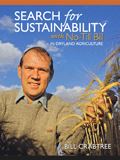
Search for Sustainability in Dryland Agriculture
This book is for those who would like to know where no-till has been, where it is going and how to do it on your farm. Whether you are a newcomer to no-till or an experienced practitioner this book has something for you.
Bill Crabtree has been researching and extending no-tillage for 25 years and is well respected for his work throughout Australia and the world.
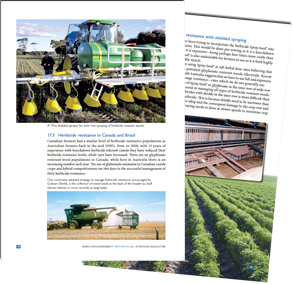
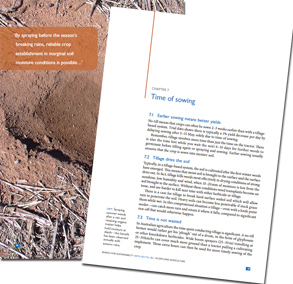
See some sample pages
Click on the image below. To turn the page, click in the top or bottom corner of each page (requires Flash).
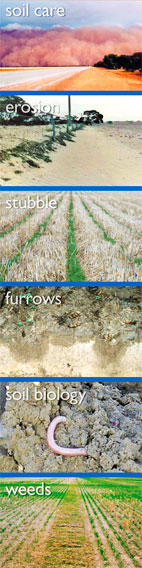
Outline of Contents
Preface
Chapter 1: The search for sustainable agriculture
Chapter 2: Background to Australian agriculture
- 2.1 Australia is 80% desert
- 2.2 Western Australian agriculture is young
Chapter 3: Definitions – what is no-till?
Chapter 4: Adoption of no-till in WA and Australia
- 4.1 No-till adoption patterns in WA
- 4.2 No-till uptake in other states
- 4.3 Knife points take no-till forward in WA
- 4.4 World-wide adoption of no-till
Chapter 5: Overview of benefits of no-till
- 5.1 Improved farm management efficiencies
- 5.2 Fewer banks and drains and more up and back
- 5.3 Earthworms become profoundly active
Chapter 6: Weed control is superior with no-till
- 6.1 Discs best in some environments for weeds
- 6.2 Increasing herbicide resistance weeds
- makes farmers embrace no-till
- 6.3 Trifluralin and no-till – go together like a hand in a glove!
- 6.4 Trifluralin still works in stubble and on the seed
- 6.5 Harrows encourage ryegrass to germinate
- 6.6 Complement with soluble herbicides
- 6.7 Soluble herbicides put to the test!
- 6.8 No-till made ryegrass control more achievable
- 6.9 Changing weed populations
- 6.10 South American weed suppression
- 6.11 Low dose rates speed resistance
Chapter 7: Time of sowing
- 7.1 Earlier sowing means better yields
- 7.2 Tillage dries the soil
- 7.3 Time is not wasted
- 7.4 Moisture is conserved
- 7.5 No-till seeders penetrate dry soils
- 7.6 Soils soften through time
- 7.7 More even paddock soil moisture
- 7.8 Surface sealing rarely occurs
Chapter 8: Better plant–water relations
- 8.1 The furrow harvesting effect
- 8.2 Ground cover limits moisture loss
- 8.3 More efficient fertiliser in bands
- 8.4 Slower early growth
- 8.5 Less early tillering
- 8.6 Softer subsoil with no-till
Chapter 9: Greater biological activity
- 9.1 Softer soil
- 9.2 Increased earthworms indicate more biological activity
- 9.3 Free Nitrogen from soil bacteria
- 9.4 Arbuscular mycorrhizea (AM)
- 9.5 Negative biological activity
- 9.6 Suppressive soils
Chapter 10: Increased macro soil biology
- 10.1 No-tilled soil is biologically different!
- 10.2 Immigratory pests ‘r’
- 10.3 Steady state ‘K’ effect
- 10.4 Monitoring is useful and educational
- 10.5 Use precision insecticide placement
- 10.6 Slugs and snails
- 10.7 Understanding biological systems
Chapter 11: Type of openers
- 11.1 Buffalo #1 and #2
- 11.2 Disc openers
- 11.3 Knife openers
- 11.4 Closer tools with knife openers
- 11.5 Depth of opener
- 11.6 Dedicated banding seeders
- 11.7 Leading coulters
Chapter 12: Seeder set-up for stubble management
- 12.1 Modifying existing seeders
- 12.2 Residue managers
- 12.3 Shape of tine and trash tubes
Chapter 13: Press wheels and harrows
- 13.1 Firming the seed zone
- 13.2 Loose soil over the firmed seed
- 13.3 Shape of press wheel
- 13.4 Downward pressure of press wheels
- 13.5 Internal pressure of press wheels
Chapter 14: Fertiliser systems and issuesd.
- 14.1 Topdressing fertiliser
- 14.2 Apply softer forms of fertiliser
- 14.3 More liquid fertilisers
- 14.4 Banding fertilisers
- 14.5 Ca:Mg ratios
- 14.6 Lime movement and no-tillage
Chapter 15: Rotations and cover crops
- 15.1 Crop diversity and sustainability
- 15.2 Water use intensity
- 15.3 Cover crops and sustainability in South America.
- 15.4 Cover crops for Australian agriculture
Chapter 16: Some challenges with no-till
- 16.1 Slugs, snails, mites, grubs, mice, weevils, beetles and grubs
- 16.2 Root lesion nematodes
- 16.3 The trace elements
- 16.4 Getting through stubble
- 16.5 Water-logging
- 16.6 Frost management
Chapter 17: The herbicide resistance issue
- 17.1 Herbicide resistance becomes common
- 17.2 Herbicide resistance in US and Argentina
- 17.3 Herbicide resistance in Canada and Brasil
- 17.4 Managing resistance with shielded spraying
Chapter 18: When might a full tillage be unavoidable?
- 18.1 Rough paddocks
- 18.2 Water repellent sands need tillage and clay
- 18.3 Naturally occurring soils with severe acidity
Chapter 19: Salinity in Western Australia
- 19.1 Result of removing perennials
- 19.2 Greater water use needed
- 19.3 Deep drains
Chapter 20: Stock and their fit with no-tillage
- 20.1 Sheep and light soil
- 20.2 Sheep and heavy soil.
- 20.3 Sheep remove soil cover
Chapter 21: Economics of no-tillage.
- 21.1 Short-term economic paddock comparison
- 21.2 Long-term economic benefits
Chapter 22: Where to next?
- 22.1 Controlled traffic
- 22.2 Variable rate agriculture
- 22.3 GPS guidance
- 22.4 Wide row technology and shields
- 22.5 GM crops
Chapter 23: No-till on the prairies with Scott Day
- 23.1 The climate in brief
- 23.2 The soils in brief
- 23.3 Wildlife on the farm
- 23.4 Hogs complemented grain for 45 years
- 23.5 Weed concern with no-till
- 23.6 An organic experience
- 23.7 Sustainable agriculture requires no-till
- 23.8 Drawbacks to no-till
- 23.9 Evolving no-till system
- 23.10 Hoe openers predominate
- 23.11 Harvest is a priority
- 23.12 The herbicide tolerant and GM canola systems
- 23.13 Herbicide resistant weeds
- 23.14 Rotational diversity is important
- 23.15 Conclusion
Chapter 24: No-till in Southern Brasil with Ademir Calegari
Chapter 25: No-till in Europe with Wolfgang Sturney
Chapter 26: Impact of Australia rejecting GM canola
- 26.2 GM canola trial data
- 26.3 Problems with TT canola
- 26.4 Economic assumptions
- 26.5 Dry wheatbelt needs crop diversity
- 26.6 Some real GM concerns
Chapter 27: How did I get into no-tillage?
Chapter 28: Crabtree publications
Cost
AUD $50 + GST (AUD $55)
plus postage and packaging.
Postage within Australia AUD $10
Postage outside Australia US $15

Peer Reviews
'In the early days, many people associated with no-till, be it farmers, researchers or extension advisors, would hit a problem and conclude "no-till doesn't work" or "doesn't work here". However, it was very refreshing to experience the steely determination of ‘No-till Bill’, who had the attitude of "Well, what is wrong with the system, and how can we get around it to make no-till work better? " Having been involved in many robust group discussions with Bill, I have appreciated his in-depth technical knowledge and widespread hands-on experience, his ability to think outside the square and to take on new challenges to find honest answers. Bill has played an important role as South Australian farmers followed the lead of Western Australian no-till farmers, speaking at fi eld days, providing key information, hosting tours to WA, and generally lifting our vision as to what was possible. I have appreciated his enthusiasm, his humour, and even his musical ability as we have performed songs together about no-till at fi eld days. I'm sure this book will see many no-till enthusiasts studying the information, looking for that gem that might just make things click into place for them—and they won't be disappointed. Bill, you're an ornament to the game!'
Chris McDonough
Department of Primary Industries and Resources of South Australia (PIRSA)
'Bill has produced and written a book I couldn't put down. Farmers, consultants and lovers of the land will fi nd this book a ‘must have’ in their pursuit of sustainable food production via no-till farming. Bill writes in his wonderful punchy manner of getting straight to the point and covers the remarkable history of no-till adoption and adoption around the world and how it was almost always farmer-lead, not researcher-lead. No-till has been a saviour for so many areas of the agricultural world and this book is an excellent tool in spreading this superior method of farming. It is a great read for anyone wanting to get into no-till farming.'
Wayne Smith
Independent Agronomist and fellow no-till pioneer. www.agronomy.com.au
More pages